


The history and significance of the Commemorative Stone in memory of the victims of poverty, placed on 17th October 1987 in Paris, and its replicas around the world.
By Huguette Redegeld (from France)

Like a child receiving the gift he had hoped for in the depths of his heart without knowing it, I was astonished to discover the enormity of the event I was participating in, alongside thousands of others: the commemoration in tribute to the victims of poverty on the Forecourt of Liberties and Human Rights in Paris. This took place on 17th October 1987.
“ In 1963, I had responded to Joseph Wresinski‘s call to invest the best of myself — at least to try — so that poverty would recede, even disappear. But I could not have imagined that this would lead me to this symbolic place, facing the Eiffel Tower, where an inscription would be engraved on a Commemorative Stone, in marble, calling for unity in the respect of human rights for all — a living call, a call exposed to all winds, a call offered to all. . ”
Is this the reason why, since then, thousands of people have taken it up and spread it in turn?
I remember.
It was 28th October 1989, two years after the inauguration of the commemorative stone in Paris. Citizens from Réunion of all backgrounds took the initiative to install a replica of this stone in a highly symbolic cultural location, the Forecourt of the “Champ Fleuri” Theater in Saint-Denis.
“ It was in 1992. The news caused quite a stir. Cassam Uteem, then President of the Republic of Mauritius, was among the first signatories of the petition launched by Javier Pérez de Cuéllar, asking the UN to recognise the International Day for the Eradication of Poverty — which was achieved with the adoption of a resolution by the UN General Assembly. . ”
It was 17th October 1993. By presidential proclamation, 17th October was declared National Day in the Philippines. On that day, a replica of the Commemorative Stone gathered a crowd from all walks of life at Rizal Park in the heart of Manila. Later, other replicas were created in other places in the country.
It was 17 October 1996, the International Year for the Eradication of Poverty. At United Nations Headquarters in New York, the Government of France offered the United Nations a replica of the Dalle replicating the message of Joseph Wresinski in the six official languages of the UN. Already, as early as 1993, every year celebrations united a wide range of people at the headquarters of the Organization, in the name of their humanity .
That same year, in Manéga, Burkina Faso, Titinga Pacéré had built near his museum the “sacred African Commemorative Stone,” as he called it. Around the outline of a massive monument reproducing the African continent, Joseph Wresinski’s message is presented in several African languages. Every 17th October, young and older people march together from the capital, Ouagadougou, to the “sacred stone.”
A few years later, in 2004, in Mauritius, in front of the Water Front in Port Louis, a replica was created in the form of a very original artistic creation symbolising water, a shared and precious heritage of humanity.
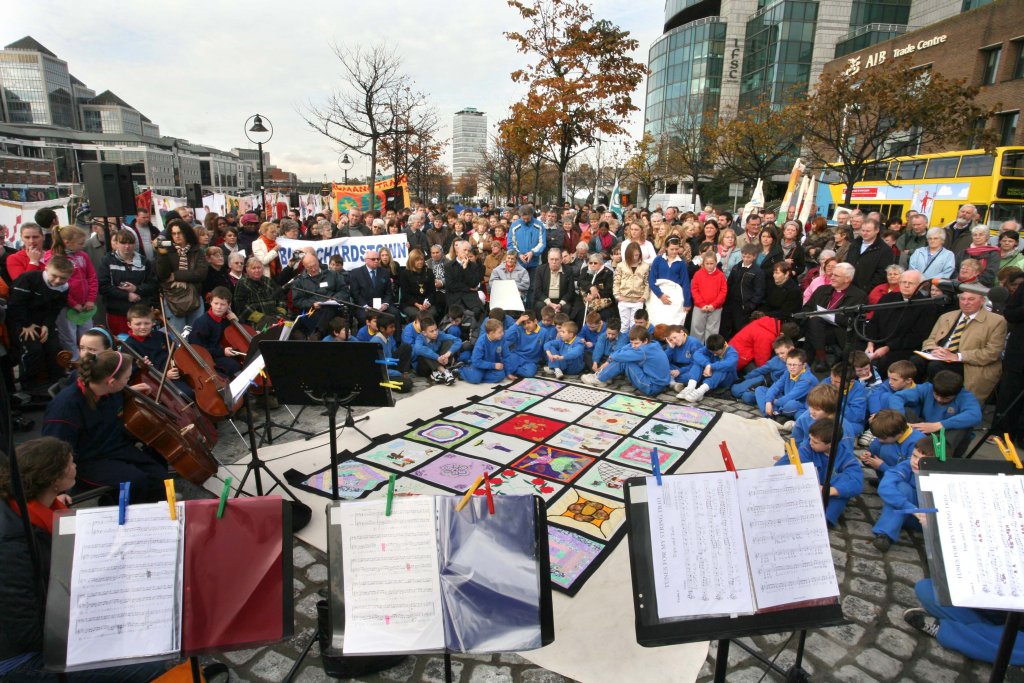

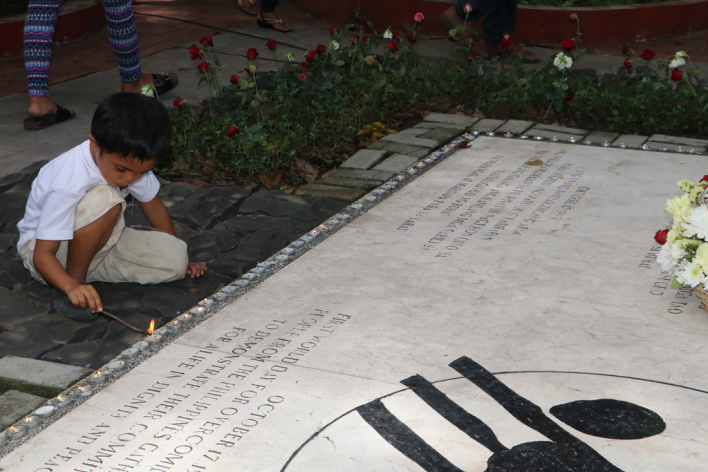
And… and…
I remember and I wonder.
How is it that today there are more than fifty replicas of the Commemorative Stone around the world, with more in the works?
Replicas, all different from one another, placed on the ground, or mounted on a wall, in a symbolic location, or symbolised by an artistic creation. All laden with history, memory, struggles, culture, spirituality: on the forecourt of an international institution, or a place of spirituality, on the wall of a town hall, in a “Place of Hope”, in a cultural centre, next to a Memorial for the victims of famine, and elsewhere.
“ I have no answer, but I have a conviction. The Commemorative Stone and its replicas, carrying Joseph Wresinski’s call, respond to our quest for unity, our thirst for harmony and peace, our search for justice and fraternity. They lift us up; they awaken the best in us. They are part of the world heritage of humanity. . ”
We invite you to explore the replicas of the Commemorative Stone at Trocadéro on the interactive map of the Forum.